Snooker burst onto our screens in 1969 thanks to then BBC Controller (and famous natural history broadcaster) Sir David Attenborough. In search of a programme that would showcase the BBC’s colour television broadcasts (introduced in 1967), it was Attenborough who came up with the idea of showing snooker on TV. The result was Pot Black, a tournament played over single frames, packaged in half-hour episodes. Snooker was perfect for the job, with it’s green baize and coloured balls. Add in the colourful characters that were playing the professional game and snooker gained traction, becoming a national phenomenon by the mid-1980s, where over 18 million UK viewers tuned in live as they watched Dennis Taylor defeat Steve Davis in the 1985 World Championship final-frame black ball decider. A year later, ‘Snooker Loopy’ from the Matchroom Mob with Chas and Dave would enter the top 10 of the UK music charts.
In the first article in this series about the history of snooker, we’re going to go back in time to look at where the game began, discover how it grew and then struggled to maintain itself as a professional sport until it struck the big time with the advent of colour television.
Origins in Billiards
Snooker is an off-shoot of billiards, a table-top game that was first played in the 15th Century. Even billiards was an evolution of a croquet-style lawn-based game originating in the 1340s.The first known indoor billiards table was owned by France’s King Louis XI, who ruled as monarch from 1461-1483. It could have been created to allow the game to be played in rain-proof conditions. The ‘Sun King’ Louis XIV (reigned 1643-1715) further popularised the playing of billiards, inspiring the rest of the French nobility to get involved. By the mid 18th Century, billiards could be seen played in almost every Parisian café. It was around this time that the game was starting to become popular with members in the gentry (those in the social class just below nobility) in England. There were many forms of billiards games, from table-top croquet-style games, table-top obstacle games that could be reminiscent of modern miniature golf, to pocket billiards from which the likes of snooker and pool branched out of.

17th Century billiards game
Invention of Snooker
Billiards became popular within the British Army regiment that was stationed in Jubbulpore, India during the 1870s, and during this time they devised several variations of the game. One of these was a fusion of the games Pyramid Pool and Black Pool. Pyramid Pool involved using 15 reds arranged in a triangle, and Black Pool involved potting balls in a specific order. With the addition of more coloured balls, this was the invention of snooker. In 1882 the rules of the game were finalised by British Army officer Colonel Sir Neville Chamberlain, who had helped devise and popularise the game in Ootacamund, India. The name snooker came from a slang term used to describe new recruits. Chamberlain had used it against an opponent who missed an easy shot, but when he then realised that they were all new to the game, he suggested they name the game after it and it caught on.
Snooker in England
The game was introduced to England by John Roberts, who was then the British Billiards Champion, in 1885. Roberts himself had learned about the game after meeting Chamberlain during a visit of India. However, snooker was initially eclipsed by the already established game of billiards. It was after the sport was featured in an issue of Sporting Life in 1887 that it started to gain more popularity on these shores. At first, the game was mostly played by military officers and the upper class, with many gentlemen’s clubs refusing to admit non-members entry to play. In response to this, smaller clubs were formed over time so that snooker was more open to the public. By 1916, the first official snooker tournament was played: the English Amateur Championships.
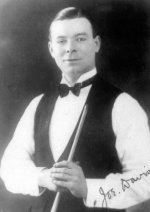
Joe Davis
Professionalism and the World Championship
In 1919, the newly formed Billiards Association and Control Club established a standardised version of the rules for snooker. It wasn’t long after the rules were standardised that the first World Championship took place in 1926/27. It was won by Joe Davis, who would dominate the competition by winning all 15 editions of it until he retired in 1946 (he also won the World Billiards Championship, becoming the first player to win the ultimate prize in both codes). Davis’ professionalism helped to elevate snooker from a recreational game to a professional sporting occupation, and by the 1930s snooker had overtaken billiards as Britain’s most popular cue sport.

Joe Davis playing snooker
Decline and Revival
Snooker began to wane in popularity following Davis’ retirement and the end of World War 2, so much so that only two players contested the World Championship in 1952. There were so few professional players that the premier tournament was then played on a challenge-match basis but that only lasted until 1957. For 7 years there was no World Championship tournament until it was revived in 1964. No-one could have forecast it then, perhaps even the man himself, but Attenborough’s decision to televise the sport completely changed snooker’s fortunes and set it on an upwards trajectory. It resulted in snooker clubs opening up all over the country and sponsors eagerly signing up to invest in the sport.
In future addition’s to this History of Snooker series, we’ll pick up the story from 1969 as snooker transformed from a minority sport to a spectacle that couldn’t be missed.
Sources:
https://en.wikipedia.org/wiki/Cue_sports,
https://en.wikipedia.org/wiki/Snooker,
https://www.express.co.uk/entertainment/books/1754349/snooker-history-david-attenborough-bbc-pool,
https://www.history.co.uk/history-of-sports/history-of-snooker-and-pool
For more info about snooker: