A New Theatre Required
The Crucible Theatre is the iconic home of the World Snooker Championship. It’s roots go back to 1966 when, on 24th August 1966, plans for a new £700,000 playhouse were announced by Sheffield City Council (then the ‘Corporation’). A new building was required because the pre-existing Sheffield Playhouse was scheduled for demolition within the next ten years to make way for a road-widening scheme. The Playhouse only accommodated 547 spectators so they planned for the new theatre to hold significantly more, initially aiming for 800-900. A central site was to be obtained as soon as possible for development, with the Crucible now located at the junction of Norfolk Street and Arundel Gate in the centre of Sheffield.
In 1967, the Sheffield Playhouse appointed advisors to guide them in how to form the organisation and administration that would be required for when they moved into the new building, and took advice on how to raise funds for it. In this year the New Sheffield Theatre Trust was formed to take charge of the project. The intention was to create two theatres (a main one and a smaller one for experimental productions and pioneering work), a concourse, a grill bar, a theatre bookshop, and a large buffet bar. The building was to be constructed of honey coloured masonry blocks with a dark contrast coloured pitch roof.
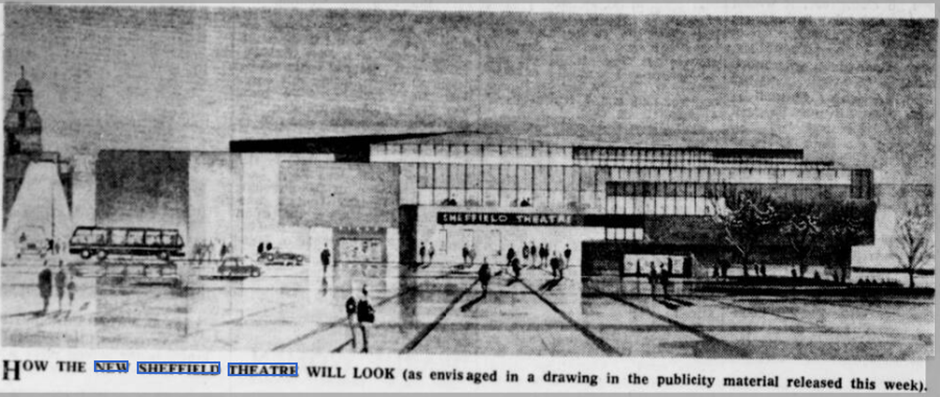
The concept art for the ‘New Sheffield Theatre’ (South Yorkshire Times and Mexborough & Swinton Times – Saturday 07 June 1969)
Announcing the Project
The official announcement to unveil the project was made on 3rd June 1969. The theatre was intended to be used as much as possible: for music exhibitions, displays, and a whole range of activities – and to establish where possible a link between the plays and the period they were set in. The theatre was to employ a thrust stage, a three-sided stage that the audience would sit around, which was to be the first of its kind in the North of England. Use of such a stage had already proved successful in Chichester, Minneapolis, and New York, and evoked the spirit of theatres from times gone by such as Shakespeare’s Globe.
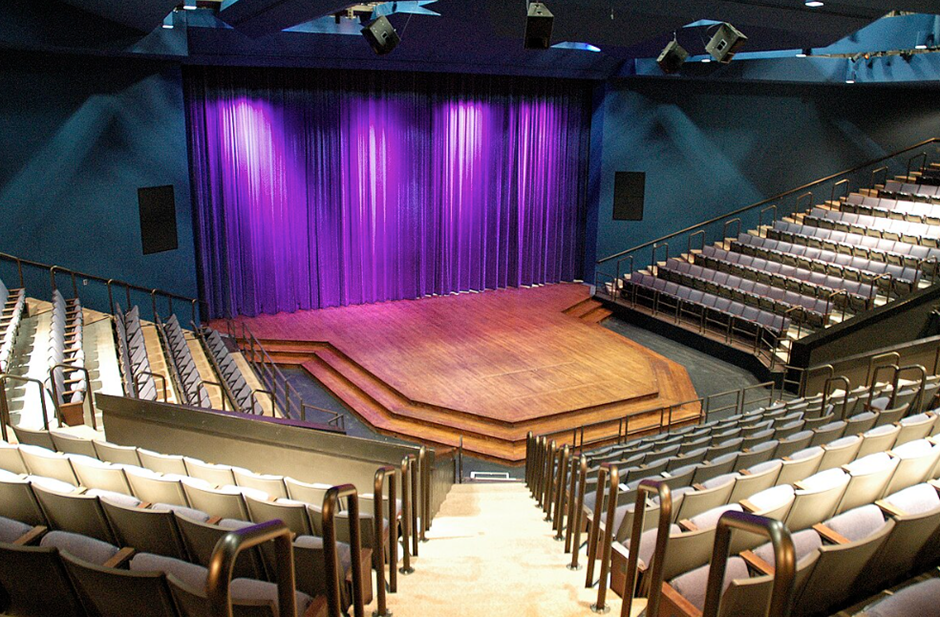
Example of a thrust stage (Wharton Center, CC BY-SA 3.0)
The Crucible’s first artistic director, Colin George, said a thrust stage theatre encouraged the involvement of the audience by bringing them closer to the action, thereby sharpening their experience. He knew Sheffield was the perfect place for such a stage after the vociferous reactions he had received to his plays in the city. No spectator would be more than 20m from the performance, despite nearly a thousand people being in attendance, and this would later contribute to the Crucible’s unique atmosphere at the World Snooker Championship.

Colin George, first artistic director of the Crucible theatre (The Stage – Thursday 11 November 1971)
Constructing the Crucible
The Crucible theatre was designed by Tanya Moiseiwitsch, who had previously worked with Sir Tyrone Guthrie, who was known for his use of thrust stages. The architects employed for the building were RHWL Architects (then known as Renton Howard Wood), while the construction was contracted to M J Gleeson, and it took two years for the building to be complete. To pay for the building, the Sheffield Corporation (council) contributed £350,000, the Arts Council £300,000, while the remaining amount of the nearly £1 million final bill was raised through public subscription – contributions came from all walks of life: industry, commerce, the Sheffield Playhouse, university, and the general public. The now Grade II listed building has a capacity of the Crucible stands at 980, while the smaller Tanya Moiseiwitsch Playhouse (originally called the Studio Theatre) holds up to 400 spectators.
Naming the Theatre
The theatre got its name after about 50 suggestions were considered. The theatre appeals organiser P. B. Keenan put forward the name, ‘Crucible’, which was formally adopted in 1970. The name was chosen for its clear association to the city of Sheffield, after the development of crucible steel in the region in 1740 charged a small township into an industrial European powerhouse over the course of a century. It was also noted that the shape of the theatre itself resembled the shape of a crucible.
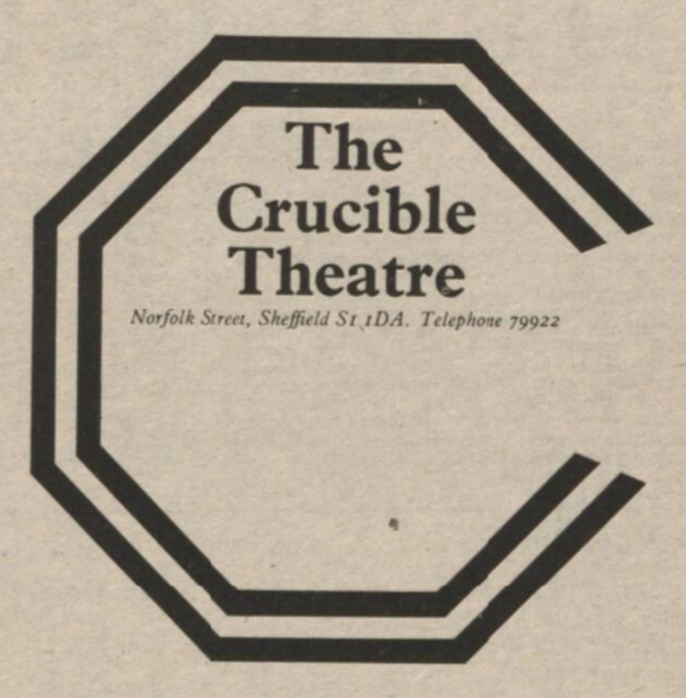
Original logo of the Crucible Theatre (The Stage – Thursday 11 November 1971)
The Crucible is Opened
The Crucible opened its doors to the public on 9th November 1971. A special inauguration production was devised by Colin George. It was called ‘Fanfare’ and was split into three parts. The first part, ‘Children’s Theatre’, involved 34 children and was designed to show how the young mind reacts to suggestion and develops in the imagination. This was followed by a performance of Anton Chekov’s ‘Swan Song’, and starred Sir Ian McKellen and Edward Petherbridge. The night was closed by a Music Hall feature. The first regular play at the theatre was performed from the next week, Henrik Ibsen’s ‘Peer Gynt’, starring Robin Gammell.
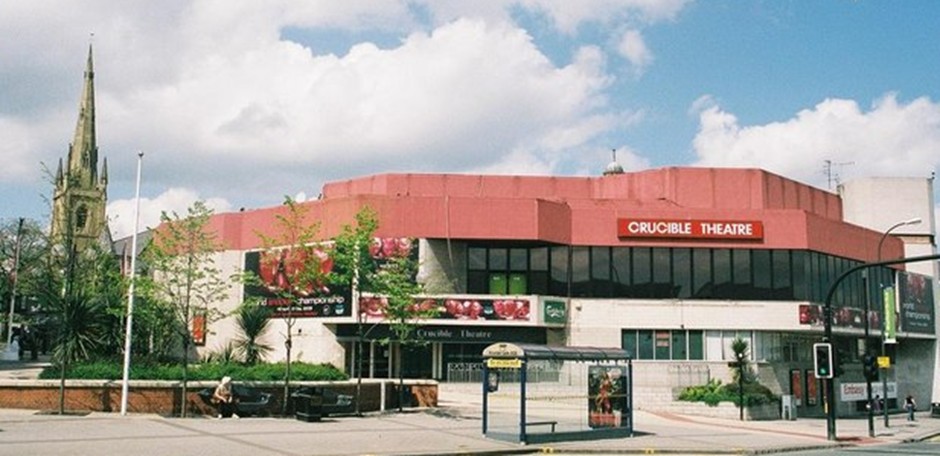
The Crucible before undergoing a £15 million renovated between 2007 and 2009 (Chris Downer, CC BY-SA 2.0)
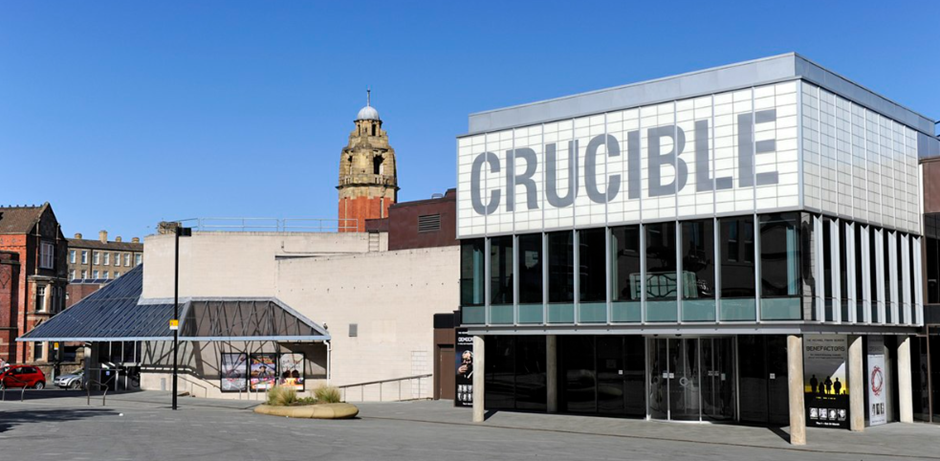
The Crucible today (The Crucible Theatre, Sheffield by Peter Tarleton, CC BY-SA 2.0)
Snooker at the Crucible
The World Snooker Championship made its first appearance at the Crucible in 1977, and has been the home of the sport’s most prestigious tournament ever since. Through snooker’s television heydays in the 1980s (peaking in 1985 when over 18 million viewers in the UK watched Steve Davis and Dennis Taylor duel beyond midnight before that final’s thrilling conclusion) to the present day, the Crucible has earned its legendary status with its intimate and dramatic atmosphere generated by crowds hugged so closely around the action on the tables. There has long been debate over whether the competition should move to a bigger, more modern venue, in a different part of the world that might offer more prize money, and some players (including Ronnie O’Sullivan) have been open to the idea, however many still believe the history, the prestige, and the experience of the World Championship at the Crucible is too important to walk away from. Snooker will remain at the Crucible until at least 2027, and whether after that it moves to a new venue in Sheffield or to another place entirely, the theatre will always retain a legendary place in snooker history.

Inside the Crucible Theatre (Steve Fareham, CC BY-SA 2.0)
If you would like to read more, check out the below links to a history of snooker, and all other blog posts on Playing Snooker: